

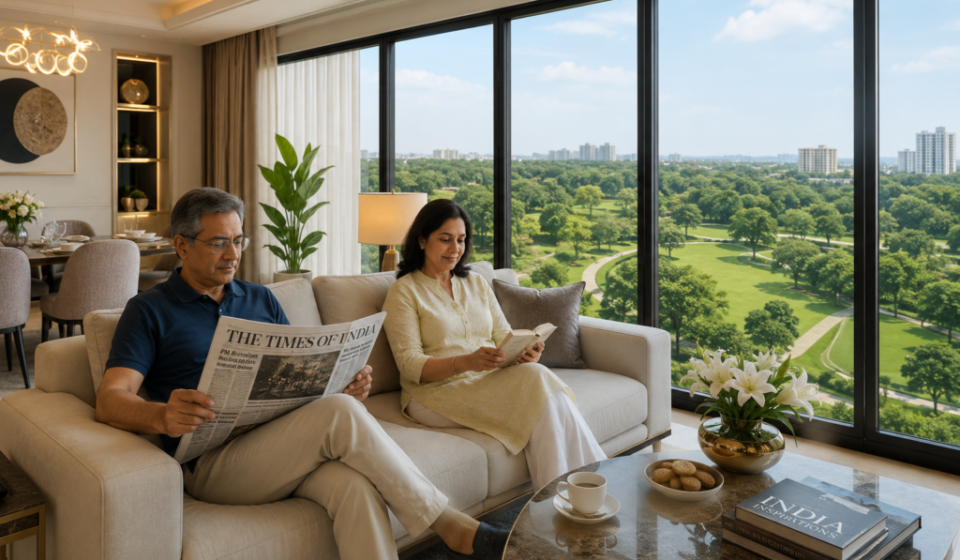

How demographic change is reshaping the future of Indian real estate.
The demographic shift is becoming impossible to ignore
India’s real-estate story is entering a new phase. The next major opportunity may not be defined only by how many homes the country needs, but by how those homes are designed for longer, healthier and more independent lives.
For decades, Indian housing has largely been organised around families, children and conventional residential formats. But demographic change is beginning to alter that equation. Longer life expectancy, smaller households, migration of children to other cities and countries, rising purchasing power and a growing preference for convenience are creating demand for a more specialised housing category: senior living.
The supplied research highlights an estimated 162.2 million Indians aged 60+ in 2025, rising to approximately 346 million by 2050. That means the older population could more than double over the period.
From conventional homes to age-friendly living
A conventional home is designed primarily around space, location and lifestyle. Senior living adds another layer: how easily can a resident continue to live independently as their needs change?
That brings accessibility, healthcare access, safety, wellness, community and daily convenience into the housing decision. The senior-living proposition is therefore less about an apartment alone and more about the ecosystem surrounding the resident.
The first image in this article represents the conventional residential experience: comfortable, attractive and lifestyle-oriented. The second image illustrates how senior living can add professional healthcare and support to that residential environment.

What are seniors actually looking for?
The senior-living buyer is not necessarily looking for a traditional retirement home. Increasingly, the proposition is about preserving independence while reducing the friction associated with everyday living.
The five core needs are independence, healthcare, social interaction, wellness and convenience. A successful community should allow residents to remain active and socially connected while giving families confidence around safety and support.
Demand is growing — but organised supply is still limited
The supplied research puts organised senior-living inventory at roughly 22,157 units as of June 2025, with market penetration at around 1.4%. It also highlights occupancy of approximately 80–85% in well-managed projects.
These figures point to an early-stage category. The opportunity is not simply to add more units, but to create professionally managed communities that consumers trust enough to make a major lifestyle transition.
The newsletter research estimates a potential ₹64,500 crore senior-living housing market by 2030, with potential target households increasing from around 1.57 million in 2024 to 2.27 million by 2030.
A ₹64,500 crore opportunity by 2030?
The newsletter research estimates a potential ₹64,500 crore senior-living housing market by 2030, with potential target households increasing from around 1.57 million in 2024 to 2.27 million by 2030.
These are market-opportunity estimates, not guaranteed sales. Actual demand will depend on affordability, location, healthcare access, operating quality, consumer awareness, financing and the willingness of families to adopt specialised senior-living formats.
Who is building India’s senior-living market?
The supplied market map highlights Ashiana Housing, Columbia Pacific Communities, Antara Senior Living / Max Group, Vedaanta Senior Living and DLF The Auréa among the players to watch.
Their importance extends beyond individual projects. Organised players are helping establish senior living as a credible real-estate and services category, while also educating consumers about managed communities, healthcare support, lifestyle programming and long-term services.

Three emerging senior-living business models
The developer leads land, construction and housing delivery while senior-focused services are integrated into the project.
The operator is central to the proposition, combining housing with hospitality-style management, activities, food, wellness, transportation and other services.
Health, preventive care, assisted living and wellness sit closer to the centre of the proposition, creating a continuum of support as residents’ needs evolve.
Senior living is moving from “home” to “ecosystem”
A senior-living community is a service-enabled ecosystem. It can connect residential space with healthcare, wellness, hospitality, security, community programming, housekeeping, transportation and future-care pathways.
This can also create recurring revenue opportunities. Instead of a one-time property transaction, developers and operators can build service revenues around healthcare, food, wellness, transportation, housekeeping and community management.
The future of senior living is not simply about providing a home. It is about creating an ecosystem around longer, healthier and more independent lives.
Why are developers paying attention?
There are four core reasons the category is attracting real-estate attention:
- Long-term demographic demand: ageing is a structural trend rather than a short-term market cycle.
- Specialised product positioning: purpose-designed senior communities can create a differentiated housing category.
- Recurring services: healthcare, food, housekeeping, wellness and transportation can create ongoing operating revenue.
- Low organised penetration: a small organised supply base leaves room for professionally managed formats to expand.
Senior living is not automatically a high-margin real-estate business. The operational intensity can be significant, and the brand promise has to be delivered consistently.
Who actually buys senior living?
The resident and the buyer may not always be the same person.
Seniors may prioritise independence, convenience and community. Adult children may prioritise safety, healthcare access and professional management, especially when they live in another city or country. Investors may focus on the emerging category and recurring-service potential.
The consumer question is shifting from “Where should I live?” to “How do I want to live for the next 20–30 years?”
What makes a good senior-living project?
A strong project requires alignment between operator capability, healthcare, services, future-care pathways, accessibility, community, security, location and wellness.
- Operator track record and management quality
- Healthcare access and emergency response
- Housekeeping, food, maintenance and transportation
- Assisted-living or future-care pathways
- Step-free access and age-friendly bathrooms
- Social spaces and community programming
- 24/7 security and emergency systems
- Proximity to hospitals, retail, transport and family networks
- Wellness, fitness and preventive-health infrastructure
The next phase: age-friendly real estate
The biggest change may be that senior living eventually stops being treated as a niche and becomes part of a broader age-friendly real-estate strategy.
Features such as step-free access, better lighting, safer bathrooms, walkable landscapes, emergency communication, smart-home technology and community spaces can improve usability for multiple generations — not only seniors.
In that sense, senior living can become a testing ground for the next generation of residential design.
The bigger opportunity: building better homes for longer lives
India’s ageing story is becoming a real-estate question. With the 60+ population projected in the supplied research to reach approximately 346 million by 2050, the industry has an opportunity to rethink what a successful home looks like across a longer lifespan.
The opportunity extends beyond constructing more apartments. It is about designing communities that support independence, health, security, social connection and dignity.
For developers, this can mean a new product category. For operators, it can mean a long-term services opportunity. For investors, it can create exposure to a demographic theme with potentially recurring revenues. And for families, it can offer an alternative to traditional assumptions about how parents should live as they age.
Bottom line: India’s senior-living market is still at an early stage, but the demographic foundation is becoming much larger. The strongest opportunities are likely to sit at the intersection of real estate, healthcare, hospitality, wellness and community.